Football is Mathematics


 Previews
 Trends
Top Trends
Trends
Top Trends
 Livescore
 Injured players
 Team Comparison
 Language


- PreviewsInsightBefore the roundFantasyOpinionMatch reportRound Overview
- LIVE predictions 1ALL predictions 3405TOP predictionsValues 106Favourites
- United Kingdom 236
- Top Europe 79
- All Europe 787
- America 181
- Africa 72
- Asia 188
 UEFA Champions League
  UEFA Europa League 18
 UEFA Europa Conference League 18
 Premier League 10
 LaLiga 10
 Bundesliga 9
 Serie A 10
 Ligue 1 9
 Eredivisie 9
 Liga Portugal 7
Can Argentina Defend the World Cup Crown? The Odds Against Back-to-Back Champions
 06/16/2026
1384
06/16/2026
1384
The FIFA World Cup is unarguably the most sought-after trophy in international football. However, it's the pursuit of retaining the FIFA World Cup trophy that is widely recognized as the most formidable challenge in international sport. Can Argentina and Lionel Messi do what seems nigh-impossible and actually defend the World Cup crown? Here are Forebet's thoughts on the matter!
As the 2026 edition of the tournament kicks off across North America, the reigning champions, Argentina, stand on the threshold of potential sporting immortality. However, they must confront not only a highly competitive field of modern heavyweights but also the psychological and physical weight of footballing history. Throughout the 96-year history of the World Cup, only two nations have ever managed to defend their crown: Vittorio Pozzo’s Italy in 1934 and 1938, and the iconic Brazilian side of 1958 and 1962.
No team has accomplished this feat in the 64 years since 1962. Argentina's manager, Lionel Scaloni, enters the tournament seeking to join Pozzo as the only coach in history to secure back-to-back world titles. Yet, the road to a fourth star is complicated by a grueling transitional period, a massive tournament expansion, an intense Group J, and highly motivated elite rivals.
The History and Precedent of Retaining the Crown
To comprehend the scale of Argentina's task of defending the World Cup Crown, we must examine the rare instances of successful title defenses and the structural reasons why subsequent champions have collapsed under the pressure of the crown.
The Historic Precedents: Italy (1938) and Brazil (1962)
Vittorio Pozzo’s Italy secured back-to-back triumphs in 1934 and 1938 by implementing a training regimen deeply rooted in physical conditioning, lifestyle control, strict discipline, and tactical flexibility. Under Pozzo's rigorous leadership, the Azzurri navigated highly hostile political environments and intense pressure, defeating Hungary 4-2 in the 1938 final in Paris to cement their legacy.
Twenty-four years later, Brazil achieved the same feat in Chile. Unlike Pozzo's single-coach model, Brazil’s consecutive titles were overseen by two different managers: Vicente Feola in 1958 and Aymoré Moreira in 1962. The 1962 campaign remains the ultimate testament to squad depth and tactical resilience. Brazil lost their star player, Pelé, to a severe injury in the group stage. Rather than collapsing, the squad adapted; Garrincha assumed a legendary starring role, scoring braces in the quarterfinals against England and the semifinals against Chile, while Amarildo, Zito, and Vavá secured a 3-1 victory over Czechoslovakia in the final.
However, Brazil’s subsequent quest for a third consecutive crown in 1966 ended in a group-stage exit in England, demonstrating that even the most talented assemblies of players are highly vulnerable to physical burnout and tactical adaptation.
The Champions' Curse of the Modern Era
In the 21st century, the structural and physical demands of the sport have given rise to the "Champions' Curse," a phenomenon where reigning holders frequently collapse not just in subsequent World Cups but in the group stages too!
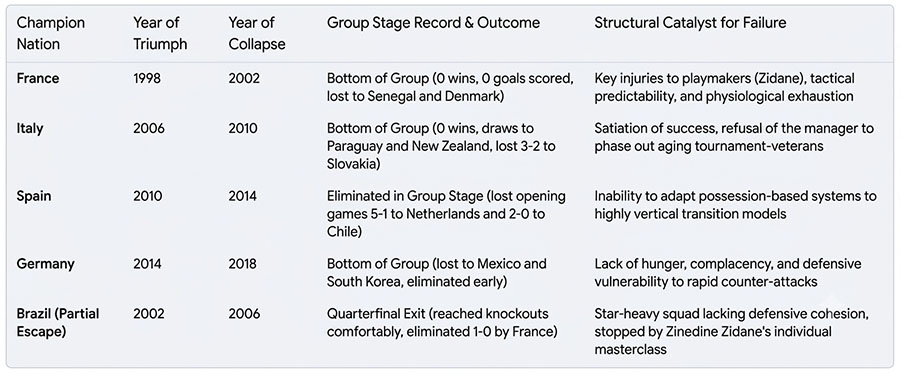
Of course, these are just a few cases and there are examples of the opposite too. Most recently, 2018 champions France not only didn't "collapse," but had an amazing 2022 World Cup performance and managed to reach the final where they didn't even lose in full-time (drew 3-3) but finally lost on penalties to Argentina.
Tactical Framework and Scaloni's Transition Model
Argentina's final 26-man squad, officially submitted on May 28, 2026, reflects a delicate balancing act. Scaloni must integrate the tournament-proven winners of the 2022 cycle with a highly dynamic crop of younger players tasked with filling the void left by retired legends such as Angel Di María.
To support him, Scaloni relies on an experienced and cohesive coaching staff consisting of assistant coaches Pablo Aimar, Roberto Ayala, and Walter Samuel, alongside goalkeeping coach Martín Tocalli.
The Dynamic 4-3-3 System and Midfield Shield
Scaloni's tactical blueprint continues to utilize a base 4-3-3 formation designed to control the center of the pitch and execute rapid vertical transitions.
This structural layout is highly fluid. To accommodate Lionel Messi, who celebrates his 39th birthday during the tournament, the right-sided central midfielder, Rodrigo De Paul, plays a vital role. De Paul acts as a defensive shield on the right flank, covering massive amounts of turf to protect Messi from defensive tracking responsibilities.
In possession, Alexis Mac Allister operates as the primary tempo conductor in the left half-space, while Chelsea’s Enzo Fernández anchors the midfield, edging out Atlético Madrid's Thiago Almada due to his extensive 2022 tournament experience. Up front, Lautaro Martínez and Julián Álvarez provide intense defensive pressing and vertical runs, while the 21-year-old FC Como midfielder Nicolás Paz offers an unpredictable, creative option off the bench. Quite a few of these players had pretty tumultuous and even underwhelming seasons at club football level and it remains to be seen if they'll perform up to expectations on the World Cup stage.
Group J: Tactical Profiles of the First-Round Challengers
Argentina is placed in Group J alongside Algeria, Austria, and Jordan. While on paper the world champions are favored to top the group, Austria and Algeria - sitting at 24th and 28th in the FIFA rankings respectively - are boasting impressive team compositions. The contrasting tactical identities of Argentina's opponents may represent highly specialized challenges.
Austria: High-Intensity Gegenpressing
Under the management of Ralf Rangnick, Austria has emerged as one of Europe's most cohesive and aggressive units, qualifying directly for their first World Cup in 28 years by topping UEFA Group H. Austria finished ahead of Bosnia and Herzegovina, Romania, Cyprus, and San Marino, recording six wins from eight matches and conceding only four goals. Their qualification was secured on the final day with a 1-1 draw against Bosnia and Herzegovina, courtesy of a 77th-minute equalizer from Michael Gregoritsch.
Tactically, Rangnick implements a highly intense, vertical gegenpressing model. Led by captain Marcel Sabitzer in the midfield half-spaces and all-time top scorer Marko Arnautović up front, Austria seeks to disrupt the opponent's build-up play in high areas.
Algeria: Organized and Pragmatic Defensive Blocks
Algeria qualified for their first World Cup since 2014 by topping Group G in CAF qualifying, collecting 25 points from 10 matches. Managed by Vladimir Petković, who is a highly regarded for his tactical discipline during a seven-year spell with Switzerland, the "Desert Foxes" are built on defensive efficiency and structure. Petković has enjoyed an outstanding start to his tenure, recording 27 wins, 9 draws, and only 3 defeats in his first 39 games. Under his system, Algeria concedes an average of just 1.1 goals per game in victories, keeping clean sheets in half of those wins.
Jordan: The Low-Block Debutant
Making their historic World Cup debut under manager Jamal Sellami, Jordan represents a highly disciplined, pragmatic underdog. Employing a deep, compact low-block, Al-Nashama relies on a tireless collective work ethic to frustrate superior opponents and minimize space in the defensive third. While on paper they are the weakest team in Group J, their deep defensive lines will force Argentina to execute slow, physically demanding possession phases, potentially draining valuable energy from Scaloni's squad.
The 48-Team Paradigm Shift and Physiological Burden
The most significant structural hurdle facing Argentina’s quest to defend the title is the expansion of the World Cup format. The transition from a 32-team tournament to a massive 48-team bracket radically alters the physical and tactical demands of winning the trophy.
Comparative Format Breakdown: 2022 vs. 2026
To appreciate the scale of this structural change, the physical parameters of the two formats must be compared directly.
This new format expansion introduces several critical physiological challenges. Finalists must now play eight matches over a 39-day period under intense environmental conditions, including long-distance travel across three host countries, multiple time zone changes, and varied climates. Instead, former tournaments included seven matches for the finalists, a 29-day tournament duration and typically much shorter distances to travel, and much more consistent climate to play in.
The Elimination Gauntlet: Analyzing the Elite Contenders
Should Argentina successfully navigate Group J and the newly introduced Round of 32, they must run a gauntlet against highly motivated global heavyweights in the deeper elimination stages.
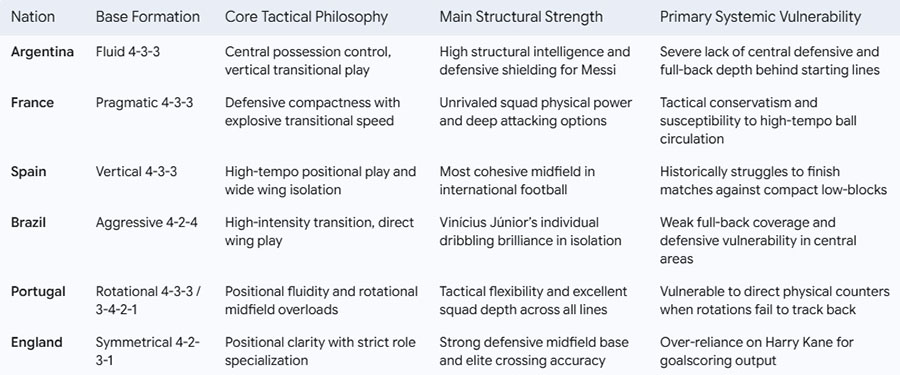
France: Physical Power and Unmatched Attacking Depth
Didier Deschamps’ France were ranked as FIFA #1 for quite a while (before a friendly loss to Ivory Coast) and represents the absolute standard of tournament pragmatism and physical power. France is highly compact, utilizing a deep defensive structure to absorb pressure before launching devastating vertical attacks. In March 2026, Deschamps released the "handbrake" during a US tour, scoring five goals in two games against Brazil and Colombia to show a more unpredictable attacking style.
Spain: High-Tempo Positional Control
Luis de la Fuente’s Spain enters the World Cup building on their Euro 2024 triumph and a subsequent Olympic gold medal in Paris, where they defeated France 5-3. De la Fuente has evolved Spain's traditional tiki-taka identity into a much faster, direct style of play. In a historic selection decision, de la Fuente named a World Cup squad with no Real Madrid players for the first time.
The Spanish system is built on possession dominance, anchored by central midfielders Rodri (the 2024 Ballon d'Or winner), Pedri, Gavi, Fabián Ruiz, and Martín Zubimendi. This exceptional midfield control is translated into vertical penetration via their highly dynamic wingers, Nico Williams and teenage prodigy Lamine Yamal, who turns 19 on July 13, just days before the final.
Brazil: Direct Transitions under Ancelotti
In May 2025, Brazil made the historic appointment of Carlo Ancelotti, who departed Real Madrid to become the Seleção's first-ever foreign head coach. Just before the tournament, Ancelotti agreed to a four-year contract extension running through the 2030 World Cup. Ancelotti took over a side that had struggled in qualifying, sacking Dorival Júnior in March 2025 after a 4-1 loss to Argentina. Under Ancelotti, Brazil has recorded five wins, three losses, and two draws in ten games.
Portugal: Fluid Midfield Rotations
Under the management of Roberto Martínez, Portugal has built a highly versatile squad, securing qualification with relative ease. Martínez has fostered a deep sense of resilience and unity, dedicating their campaign to the memory of forward Diogo Jota and his brother André Silva, who tragically passed away in 2025.
Martínez's tactical setup relies on fluid midfield rotations, with João Neves and Matheus Nunes comfortably dropping into wide defensive roles, while Diogo Cancelo and Diogo Dalot play on either flank to provide tactical unpredictability.
The spine of the team is anchored by goalkeeper Diogo Costa, central defender Rúben Dias, and the creative brilliance of Vitinha, Bruno Fernandes, and Bernardo Silva. Up front, 41-year-old captain Cristiano Ronaldo is participating in his sixth World Cup, providing unmatched experience and box presence to inspire a highly talented squad.
England: Tactical Symmetries and Positional Clarity
England enters the tournament under the leadership of Thomas Tuchel, who is aiming to secure a second star on the English shirt. Tuchel has introduced a highly structured 4-2-3-1 system, prioritizing positional clarity and avoiding tactical compromises.
Tuchel’s core starting XI features Jordan Pickford in goal, Reece James and Marc Guéhi in defense, Declan Rice and Elliot Anderson anchoring the midfield, and Bukayo Saka on the right wing.
Tuchel’s biggest selection dilemma lies at the No. 10 position, where Jude Bellingham is battling Aston Villa's Morgan Rogers for the starting role, while Anthony Gordon and Marcus Rashford compete on the left flank.
Up front, captain Harry Kane remains the focal point, though English media have raised concerns regarding a heavy reliance on Kane's goals, as back-up options Ollie Watkins and Ivan Toney have been inconsistent in warm-up friendlies. Furthermore, England’s traditional threat on set-pieces may face challenges, as tournament referees have been instructed to closely monitor blocking and grappling inside the box.
So, Can Argentina Defend the World Cup Crown?
The structural, physical, and historical factors confronting Argentina are more than formidable. To defend their crown, Scaloni’s side must overcome three distinct layers of difficulty: 1) survive a physically demanding Group J, 2) mobilize for the physical toll of the expanded 48-team format, and 3) defeat a younger, highly motivated group of elite contenders in the deeper knockout rounds.
Ultimately, while the tactical structure built around Lionel Messi remains world-class, the physiological demands of the expanded tournament format and a severe pre-tournament injury crisis suggest that the physical toll of the crown may prove too heavy to carry for a second consecutive time. And, indeed, this fits with Forebet's mathematical analysis too, as our algorithm predicted last weekt hat Argentina will manage to top Group J, as well as move past the Rounds of 32 and 16 (defeating Uruguay and USA in the process), but get eliminated by CR7's Portugal in the quarter-finals. In fact, the algorithm expects Portugal to then go ahead and win the whole tournament for the first time in history!
So, can Argentina actually manage to defend the World Cup Crown? Indeed, historically, the double-crown has required a rare combination of structural depth and physical durability. Without a rapid recovery of their starting defensive line, Argentina's quest to replicate Brazil's 1962 achievement represents an uphill battle against modern football's demanding realities.
<>October 2026Football predictions{"9":"September 2026","10":"October 2026","11":"November 2026"}Mon Tue Wed Thu Fri Sat Sun 01 02 03 04 05 06 07 08 09 10 11 12 13 14 15 16 17 18 19 20 21 22 23 24 25 26 27 28 29 30 31 Group A
OVERALL TABLE OVERALL TABLE PTS GP W D L +/- 1Mexico 9 3 3 0 0 6 2South Africa 4 3 1 1 1 -1 3South Korea 3 3 1 0 2 -1 4Czech Republic 1 3 0 1 2 -4 Play-off 1/16-finalsPossible next roundGroup B
OVERALL TABLE OVERALL TABLE PTS GP W D L +/- 1Switzerland 7 3 2 1 0 4 2Canada 4 3 1 1 1 5 3Bosnia and Herzegovina 4 3 1 1 1 -1 4Qatar 1 3 0 1 2 -8 Play-off 1/16-finalsPossible next roundGroup C
OVERALL TABLE OVERALL TABLE PTS GP W D L +/- 1Brazil 7 3 2 1 0 6 2Morocco 7 3 2 1 0 3 3Scotland 3 3 1 0 2 -3 4Haiti 0 3 0 0 3 -6 Play-off 1/16-finalsPossible next roundGroup D
OVERALL TABLE OVERALL TABLE PTS GP W D L +/- 1USA 6 3 2 0 1 4 2Australia 4 3 1 1 1 0 3Paraguay 4 3 1 1 1 -2 4Türkiye 3 3 1 0 2 -2 Play-off 1/16-finalsPossible next roundGroup E
OVERALL TABLE OVERALL TABLE PTS GP W D L +/- 1Germany 6 3 2 0 1 6 2Ivory Coast 6 3 2 0 1 2 3Ecuador 4 3 1 1 1 0 4Curaçao 1 3 0 1 2 -8 Play-off 1/16-finalsPossible next roundGroup F
OVERALL TABLE OVERALL TABLE PTS GP W D L +/- 1Netherlands 7 3 2 1 0 6 2Japan 5 3 1 2 0 4 3Sweden 4 3 1 1 1 0 4Tunisia 0 3 0 0 3 -10 Play-off 1/16-finalsPossible next roundGroup G
OVERALL TABLE OVERALL TABLE PTS GP W D L +/- 1Belgium 5 3 1 2 0 4 2Egypt 5 3 1 2 0 2 3Iran 3 3 0 3 0 0 4New Zealand 1 3 0 1 2 -6 Play-off 1/16-finalsPossible next roundGroup H
OVERALL TABLE OVERALL TABLE PTS GP W D L +/- 1Spain 7 3 2 1 0 5 2Cape Verde 3 3 0 3 0 0 3Uruguay 2 3 0 2 1 -1 4Saudi Arabia 2 3 0 2 1 -4 Play-off 1/16-finalsPossible next roundGroup I
OVERALL TABLE OVERALL TABLE PTS GP W D L +/- 1France 9 3 3 0 0 8 2Norway 6 3 2 0 1 1 3Senegal 3 3 1 0 2 2 4Iraq 0 3 0 0 3 -11 Play-off 1/16-finalsPossible next roundGroup J
OVERALL TABLE OVERALL TABLE PTS GP W D L +/- 1Argentina 9 3 3 0 0 7 2Austria 4 3 1 1 1 0 3Algeria 4 3 1 1 1 -2 4Jordan 0 3 0 0 3 -5 Play-off 1/16-finalsPossible next roundGroup K
OVERALL TABLE OVERALL TABLE PTS GP W D L +/- 1Colombia 7 3 2 1 0 3 2Portugal 5 3 1 2 0 5 3DR Congo 4 3 1 1 1 1 4Uzbekistan 0 3 0 0 3 -9 Play-off 1/16-finalsPossible next roundGroup L
OVERALL TABLE OVERALL TABLE PTS GP W D L +/- 1England 7 3 2 1 0 4 2Croatia 6 3 2 0 1 0 3Ghana 4 3 1 1 1 0 4Panama 0 3 0 0 3 -4 Play-off 1/16-finalsPossible next roundPick of the day
2nd1stFlamengo are undefeated in their last 13 Copa Libertadores matches.
Top trends
 Vélez Sársfield Res.Unbeaten 30 of 36
Vélez Sársfield Res. are unbeaten in 30 of their last 36 home matches in Reserve League
 Khovd FCOver 2.5 goals 19
Over 2.5 goals were seen in Khovd FC's last 19 matches in Premier League
 Hwacheon KSPO WUndefeated 15
Hwacheon KSPO W are undefeated in their last 15 league games
 URA KampalaWinless 2 of 14
In their last 14 games in Premier League, URA Kampala have a poor record of just 2 wins
 Mashal MubarekLost 10
Mashal Mubarek are on a losing streak of 10 straight matches in Professional Football League
 Sporting BragaClean sheets 6
Sporting Braga have kept a clean sheet in all of their last 6 UEFA Europa Conference League games
 FC NordsjællandWon 5
The team of FC Nordsjælland have achieved 5 straight wins in UEFA Europa Conference League
 Levski SofiaScored None 5
Levski Sofia are on an unfortunate streak of 5 Europa League games where they have not managed to score a goal
 WardLost by 3+ goals 4
Ward have lost by 3+ goals their last 4 Premier League games
 SL BenficaWon by 2+ goals 3
SL Benfica have won by 2+ goals all of their last 3 Europa League games


ABOUT
Football is mathematics. Forebet is a free data and analytics platform for football and sports predictions. It utilizes mathematical algorithms and statistical models to process historical match data across more than 850 football leagues and other major sports competitions worldwide. Since 2009, Forebet has leveraged the power of mathematical algorithms and statistical models to transform raw data into actionable intelligence, match analytics, and data-driven sports predictions for fans worldwide. The platform is designed to support informed decision-making by presenting objective probabilities and structured football and sports statistics.PREDICTIONS
MORE
Copyright © 2009-2026 Forebet.com All rights reserved.