 Футбол - это математика


 Результаты в реальном времени
 Травмированные игроки
 Сравнение команд
 Язык


- Прогнозы по ходу матча 7Прогнозы на выходные 1611Все прогнозы 2581Топ прогнозы
 Лига Чемпионов УЕФА 18
 Лига Европы УЕФА 18
 Лига конференций УЕФА 18
 Премьер-Лига 10
 ЛаЛига 10
 Бундеслига 9
 Серия А 10
 Первая лига 9
 Эредивизи 9
 Лига Португезе 9
Draws Galore: Why Are So Many World Cup Games Ending In Draws?
 DATE_FORMAT_LC5
1540
The 2026 FIFA World Cup has roared into action across North America, bringing with it a 48-team expansion, 16 groups, and a fresh wave of international football fervor. Yet, amidst the excitement of record-breaking crowds and the return of the global game to Canada, Mexico, and the United States, a curious statistical anomaly has dominated the discourse of the opening days - draws. Lots and lots of draws.
Of the first 16 matches played in the tournament, an astonishing 8 have ended in draws. This is a draws galore trend that has left analysts, fans, and pundits scrambling to find an explanation for this unprecedented level of parity. Many people's first thoughts when the tournament was expanded to include nations like Cape Verde and Curaçao was that we'll simply see more high-scoring trashing and we did see a 7-1 win for Germany against Curaçao and a 5-1 win for Sweden vs Tunisia, but the more significant trend so far is that half the World Cup games are ending in draws. So, why is that?
The Opening Act: A Statistical Snapshot
The tournament kicked off on June 11, and by the morning of June 16, the data was clear: we are witnessing a World Cup unlike any other. The following matches represent the first 16 fixtures of the 2026 group stage:
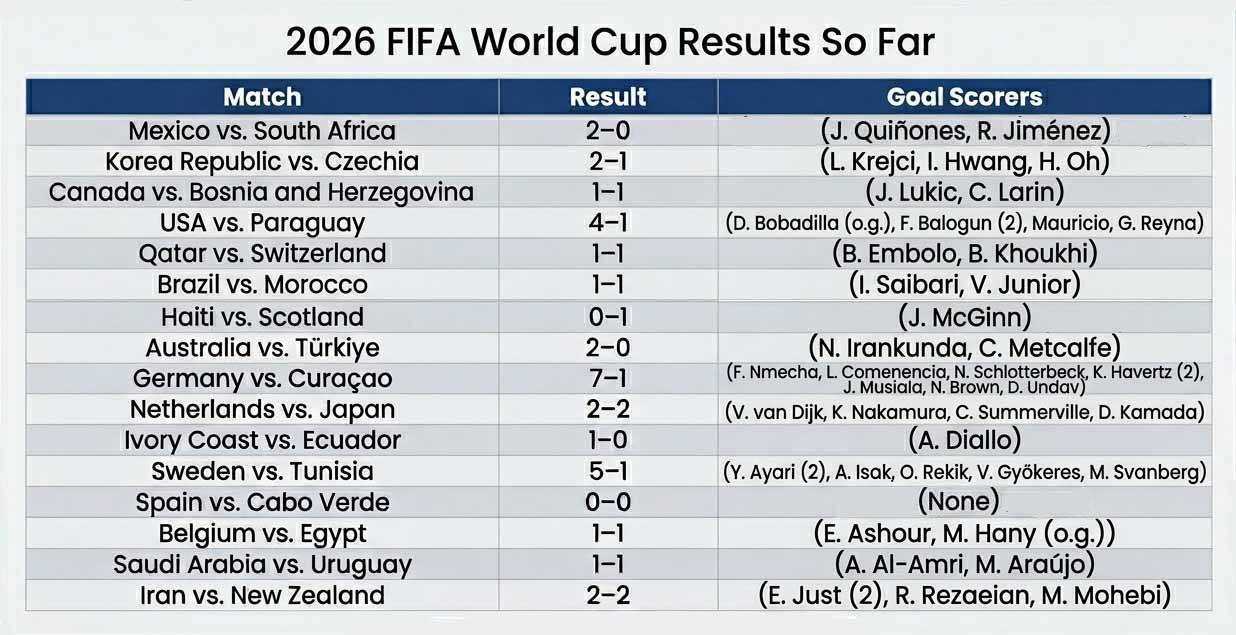
Looking at this list, the pattern becomes unmistakable. From the opening games, teams that might have been considered "underdogs" in previous eras are holding their own against established powerhouses. The draw between Belgium and Egypt, followed by stalemates for Spain and Uruguay, and the back-and-forth thriller between Iran and New Zealand, pushed the tournament to a level of parity not seen in quite a while.
Why the Surge in Draws?
The sudden influx of draws at the World Cup has sparked significant debate. Is this a coincidence, or are we witnessing a fundamental shift in the global hierarchy of football? It almost feels like fate - for years and decades Americans have complained that "All soccer games end in draw!" and now that the FIFA World Cup has returned in North America... draws galore! But what is the actual reason?
1. Narrowing the Competitive Gap
The primary theory suggests that the global gap between football nations is shrinking. Increased investment in youth academies, better access to data analytics, and the widespread migration of coaches and tactical experts have elevated the baseline for smaller nations. As seen in the Iran vs. New Zealand clash, "lower-ranked" teams are no longer simply showing up to defend, they are arriving with sophisticated game plans and the fitness to compete for 90-plus minutes. This is also why people are foreseeing so many different candidates for this World Cup's potential likely dark horse teams.
2. Tactical Rigidity and Defensive Discipline
Modern football has seen a tactical evolution where structure often trumps individual flair in the early stages of tournaments. Many teams are prioritizing defensive shape and limiting transition opportunities for their opponents. When two sides play with high levels of tactical discipline, the margin for error shrinks, and the likelihood of a stalemate increases.
3. The "First Match" Nervousness
The group stage of an expanded 48-team World Cup introduces new pressures. For many nations, a single point against a superior opponent is a massive psychological and mathematical success. This defensive pragmatism of playing for the point rather than risking all for the win has been a visible theme in the opening rounds. As the next rounds come, however, this nervousness is likely to go away, at least for some teams, and you can keep up with Forebet's prediction for the World Cup's next matches here.
A Look Ahead
While the draw trend has been the story of the opening 16 matches of the 2026 FIFA World Cup, the tournament remains in its infancy. As teams move into their second group games, the need for points will likely force managers to abandon their cautious approaches. History shows that as group standings tighten, the desperation for a win leads to more open, aggressive football.
Regardless of the final results, the first few days of the 2026 World Cup have proven one thing: the world has caught up. The "giant-killing" narrative is evolving into a story of genuine, hard-fought competition where any team, on any given day, is capable of forcing a share of the spoils This doesn't mean that Cape Verde are now on equal footing to win the whole thing alongside Spain - in fact, Forebet's prediction for the World Cup is still for the top teams to reach the quarter-finals and Portugal to win the World cup, but it definitely seems like we can expect quite a few more surprises in the group stage games and beyond.
<>Ноября 2026Футбол прогнозы{"10":"\u041e\u043a\u0442\u044f\u0431\u0440\u044f 2026","11":"\u041d\u043e\u044f\u0431\u0440\u044f 2026","12":"\u0414\u0435\u043a\u0430\u0431\u0440\u044f 2026"}Пн Вт Ср Чт Пт Сб Вс 01 02 03 04 05 06 07 08 09 10 11 12 13 14 15 16 17 18 19 20 21 22 23 24 25 26 27 28 29 30 Группа А
OVERALL TABLE OVERALL TABLE О И В Н П +/- 1Мексика 9 3 3 0 0 6 2Южная Африка 4 3 1 1 1 -1 3Южная Корея 3 3 1 0 2 -1 4Чехия 1 3 0 1 2 -4 Группа B
OVERALL TABLE OVERALL TABLE О И В Н П +/- 1Швейцария 7 3 2 1 0 4 2Канада 4 3 1 1 1 5 3Босния и Герцеговина 4 3 1 1 1 -1 4Катар 1 3 0 1 2 -8 Группа С
OVERALL TABLE OVERALL TABLE О И В Н П +/- 1Бразилия 7 3 2 1 0 6 2Марокко 7 3 2 1 0 3 3Шотландия 3 3 1 0 2 -3 4Хаити 0 3 0 0 3 -6 Группа D
OVERALL TABLE OVERALL TABLE О И В Н П +/- 1США 6 3 2 0 1 4 2Австралия 4 3 1 1 1 0 3Парагвай 4 3 1 1 1 -2 4Турция 3 3 1 0 2 -2 Группа Е
OVERALL TABLE OVERALL TABLE О И В Н П +/- 1Германия 6 3 2 0 1 6 2Кот-д'Ивуар 6 3 2 0 1 2 3Эквадор 4 3 1 1 1 0 4Кюрасао 1 3 0 1 2 -8 Группа F
OVERALL TABLE OVERALL TABLE О И В Н П +/- 1Нидерланды 7 3 2 1 0 6 2Япония 5 3 1 2 0 4 3Швеция 4 3 1 1 1 0 4Тунис 0 3 0 0 3 -10 Группа G
OVERALL TABLE OVERALL TABLE О И В Н П +/- 1Бельгия 5 3 1 2 0 4 2Египет 5 3 1 2 0 2 3Иран 3 3 0 3 0 0 4Новая Зеландия 1 3 0 1 2 -6 Группа Н
OVERALL TABLE OVERALL TABLE О И В Н П +/- 1Испания 7 3 2 1 0 5 2Кабо-Верде 3 3 0 3 0 0 3Уругвай 2 3 0 2 1 -1 4Саудовская Аравия 2 3 0 2 1 -4 Группа I
OVERALL TABLE OVERALL TABLE О И В Н П +/- 1Франция 9 3 3 0 0 8 2Норвегия 6 3 2 0 1 1 3Сенегаль 3 3 1 0 2 2 4Ирак 0 3 0 0 3 -11 Группа J
OVERALL TABLE OVERALL TABLE О И В Н П +/- 1Аргентина 9 3 3 0 0 7 2Австрия 4 3 1 1 1 0 3Алжир 4 3 1 1 1 -2 4Иордания 0 3 0 0 3 -5 Группа К
OVERALL TABLE OVERALL TABLE О И В Н П +/- 1Колумбия 7 3 2 1 0 3 2Португалия 5 3 1 2 0 5 3ДР Конго 4 3 1 1 1 1 4Узбекистан 0 3 0 0 3 -9 Прогноз на день
20.2.Палмейрас не проигрывал в 28 из последних 31 матчей Бразилейро Серии А.


О нас
Футбол это математика. Forebet это бесплатная платформа данных и аналитики для прогнозов в футболе и других видах спорта. Она использует математические алгоритмы и статистические модели для обработки исторических данных матчей более чем по 850 футбольным лигам и другим крупным спортивным соревнованиям по всему миру. С 2009 года Forebet использует мощь математических алгоритмов и статистических моделей, чтобы превращать необработанные данные в практическую аналитику, аналитику матчей и основанные на данных спортивные прогнозы для болельщиков по всему миру. Платформа создана для поддержки взвешенного принятия решений, представляя объективные вероятности и структурированную футбольную и спортивную статистику.ПРОГНОЗЫ
БОЛЬШЕ
Copyright © 2009-2026 Forebet.com Все права защищены


