 Футбол - это математика


 Результаты в реальном времени
 Травмированные игроки
 Сравнение команд
 Язык


- Прогнозы на сегодня 1041
- Прогнозы по ходу матча 12Все прогнозы 1963Топ прогнозы
 Лига Чемпионов УЕФА
 Лига Европы УЕФА
 Лига конференций УЕФА
 Премьер-Лига 2
 ЛаЛига 5
 Бундеслига 2
 Серия А 7
 Первая лига 5
 Эредивизи 5
 Лига Португезе 6
How Weather Affects Football and Match Predictions
 DATE_FORMAT_LC5
5430
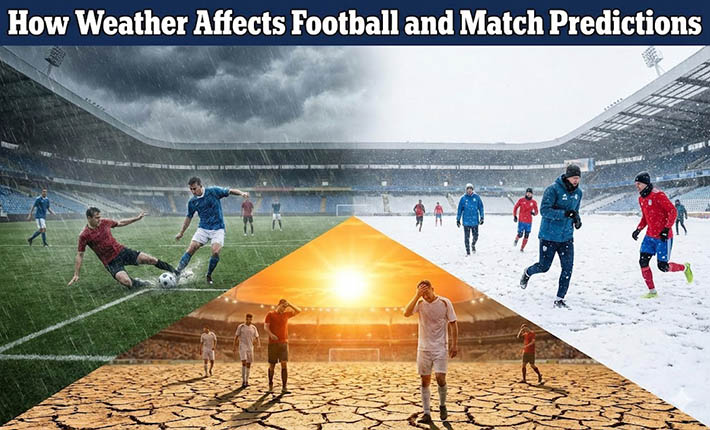
If you’ve ever watched a football match in a downpour or sweltering heat, you know the beautiful game is anything but predictable. We spend hours analyzing tactics, form, and player injuries, but often, the most influential force on the pitch isn’t a world-class striker or a masterful coach. It’s the weather.
From the relentless wind whipping across Premier League stadiums to the suffocating humidity of the Brazilian coast, climate conditions act as a true "12th man," fundamentally changing how football is played and, crucially, making life a nightmare for anyone trying to predict the final score.
The Trinity of Terror: Rain, Wind, and Temperature
To understand how climate affects results, we first need to break down the impact of the three main meteorological culprits: precipitation, wind, and temperature.
1. Rain and Pitch Conditions
Rain is the most common factor in European football, but its effect isn't always straightforward.
The Slippy Surface: Light rain turns modern grass pitches into fast, slick highways. The ball skids quickly across the surface, passes need less power, and the pace of the game naturally increases. This often favors teams with fast, technical players who rely on quick transitions and low-driven shots, as goalkeepers find it much harder to deal with shots that skip off the wet grass.
The Muddy Mess: Heavy, sustained rain, however, is a different beast. Even with modern drainage, the pitch can become heavy and slow. This drastically increases player fatigue and slows the ball down, favoring teams that rely on physical strength, long balls, and powerful running. Technical passing teams struggle as the ball stops unexpectedly, and the risk of unforced errors (like a crucial slip or miskick) skyrockets. More turnovers often mean more goals scored/conceded due to defensive mistakes.
2. The Unpredictable Wind
Wind is arguably the most random and frustrating element. A strong, swirling breeze can turn simple tactics into chaos.
Long Balls and Set Pieces: Strong wind makes long, aerial passes and goal kicks notoriously difficult. If a team is playing against the wind, a goal kick can struggle to reach the halfway line, instantly ceding territory. Conversely, playing with the wind can turn a speculative long pass into a dangerous through-ball.
Goalkeeping and Shooting: Goalkeepers hate wind most of all. It can make crosses swerve, dipping shots float, and clearances hang in the air or spin violently. This often leads to an increase in unpredictable goals from set pieces or long-range shots where the wind adds an unexpected, late deviation.
3. Temperature: The Energy Drain
While rain and wind affect the ball and the pitch, temperature directly affects the players' physiology and endurance.
Extreme Heat and Humidity: Playing in temperatures above 30°C (86°F) and high humidity drastically reduces the players' capacity for high-intensity running. Teams slow down, high-pressing tactics become unsustainable, and substitution windows (often featuring compulsory water breaks) become crucial tactical moments. Studies have suggested that higher temperatures correlate with a slightly higher average goal count (roughly 0.48 more goals for every 10°C rise), likely because players tire faster and start making late-game defensive mistakes.
Extreme Cold: Frigid temperatures stiffen muscles, slow reaction times, and increase the risk of soft-tissue injuries. While modern base layers mitigate this, the cold still encourages more conservative, pragmatic play and fewer technical risks. Games in heavy snow often become battles of attrition, favoring robust, defensive structures.
The Guessing Puzzle: Weather vs. Match Predictions
The influence of weather is a crucial input for score prediction models like the complex, math-driven algorithm used by Forebet. Our mathematical model analyzes decades of historical match data, including team form, head-to-head results, injuries, and goal averages, and increasingly integrate real-time weather data. The core challenge for any prediction model is determining how much to weight the weather variable against a team’s established historical performance. Does a 25mph wind matter more than Arsenal’s current 17-game undefeated streak?
Analyzing past results and predictions across diverse leagues shows that the effect of weather on prediction accuracy isn't uniform; it creates challenges unique to each climate.
The European Conundrum: Consistent Conditions vs. Volatility
In Europe's "Big Five" leagues (Premier League, La Liga, Serie A, Bundesliga, Ligue 1), Forebet’s algorithm has a wealth of consistent data.
Premier League (England): The primary weather challenges here are strong winds and heavy rain. Because British teams are acclimated to such conditions, however, these challenges don't have as strong of an effect on W/D/L predictions, as they do elsewhere. Strong winds do have a serious effect on Total Goals predictions and Over/Unders, however, as wind creates major variances (unpredictable shots/crosses), leading to over/under misses.
Bundesliga (Germany): The main weather challenges here are cold, frost, & heavy snow in the autumn and winter seasons. These have moderate effects on W/D/L predictions as very cold conditions favor physical, direct play, potentially causing upsets against technical teams. As for Total Goals and Over/Under predictions, the effect is very high, as pitch slipperiness or slowness affects scoring rhythm, often pushing games Under the predicted total.
Ligue 1 (France): France has one of the mildest and most moderate climates in Europe compared to the constant raining of England or the heat of southern Spain. France does have certain climate variations between its different regions, especially when looking at Atlantic vs Mediterranean provinces, but this tends to have only low to moderate effect on match predictions. Wind and rain (especially in the more humid western coast) does disrupt the flow more than in the UK, however, especially for visiting teams from the Mediterranean area, due to lack of acclimatization and less uniform pitch quality across all clubs.
La Liga (Spain): Extreme summer heat and dryness are the main weather problems for teams and match predictions here. These factors can have a high effect, especially in the early and late season, as home teams in hotter regions gain a massive advantage over traveling northern teams due to fatigue. Heat also makes goal count predictions less accurate when heat causes late-game defensive collapses.
Serie A (Italy): The key climate issues here are usually high humidity and afternoon heat. Humidity affects player stamina, leading to late-game slumps and increased likelihood of draws or narrow outcomes. This can have a moderate to high effect on match predictions, as hot conditions cause tactical changes (slower pace, less pressing).
The Global Extremes: Altitude and Tropical Heat
Predictions tend to get tougher when facing environments that introduce extreme, non-linear variables, such as conditions teams rarely encounter in their normal schedules.
South American Leagues (Brasileiro, Argentina Liga Profesional, and others): This is where climate conditions become a dominant force.
Humidity and Heat: Matches in the Brazilian Serie A are played in oppressive heat and humidity across many coastal cities. For people to predict accurately, they must not just know the temperature, but also the specific acclimatization levels of the visiting team.
For example, a team from a temperate region traveling north to the Amazonian humidity faces a fatigue deficit that no simple statistical input can fully capture.
Altitude: The sheer altitude of stadiums in countries like Bolivia, or to a lesser extent, high-altitude venues in Colombia or even Mexico, drastically changes player capacity. This gives the home side a massive, measurable advantage. To predict accurately, one must heavily overweight the home factor in these scenarios, making the difference between a predicted 2-1 home win and a shocking 0-0 draw very hard to model consistently.
African and Asian Leagues: Many African and Asian leagues contend with intense, sustained seasonal heat or, conversely, highly varied monsoon/rain seasons. In regions where pitch maintenance is less consistent, persistent rain turns surfaces into heavy mud quickly, favoring opportunistic goal-scorers over tactical playmakers. The prediction models must account for this increased 'luck' or variance caused by unpredictable pitch conditions, which often makes their goal-scoring predictions and Over/Under predictions less reliable than in the structurally consistent European leagues.
The Enduring Unpredictability
Ultimately, the best prediction models, whether from Forebet or any other high-level analyst, excel because they integrate weather and climate data. We know that a wet, windy 4°C evening in Stoke drastically changes the probability of a 4-0 scoreline compared to a sunny 25°C day in Barcelona. But this data integration will never be perfect. Football's beauty lies in its human and environmental unpredictability. A sudden downpour, a crucial mistake caused by a slick patch of grass, or an unexpected gust of wind that pushes a goalkeeper’s save into his own net - these moments defy algorithms. They are the true joy (or frustration) of football, proving that even the most complex algorithm cannot completely account for the temperamental character of the 12th man: the weather itself.
<>Ноября 2026Футбол прогнозы{"10":"\u041e\u043a\u0442\u044f\u0431\u0440\u044f 2026","11":"\u041d\u043e\u044f\u0431\u0440\u044f 2026","12":"\u0414\u0435\u043a\u0430\u0431\u0440\u044f 2026"}Пн Вт Ср Чт Пт Сб Вс 01 02 03 04 05 06 07 08 09 10 11 12 13 14 15 16 17 18 19 20 21 22 23 24 25 26 27 28 29 30 Западная конференция
OVERALL TABLE OVERALL TABLE О И В Н П +/- 1Ванкувер Уайткэпс 58 32 17 7 8 34 2Даллас 55 33 15 10 8 9 3Сан-Хосе Эртквейкс 52 33 14 10 9 8 4Ст. Луис Сити 51 33 14 9 10 10 5Хьюстон Динамо 51 32 14 9 9 3 6ФК Лос Анджелис 47 32 12 11 9 15 7Лос-Анджелес 44 33 11 11 11 -6 8Сиэтл Саундерс 43 32 11 10 11 1 9Колорадо Рэпидс 43 33 12 7 14 -1 10Реал Солт-Лейк 42 33 12 6 15 0 11Портленд Тимберс 40 32 11 7 14 -3 12Сан Диего ФК 38 33 9 11 13 -5 13Миннесота Юнайтед 38 32 9 11 12 -6 14Остин 34 33 8 10 15 -21 15Спортинг Канзас Сити 23 33 6 5 22 -42 Восточная конференция
OVERALL TABLE OVERALL TABLE О И В Н П +/- 1Нэшвилл СК 71 32 21 8 3 43 2Нью-Инглэнд 58 32 18 4 10 10 3Интер Майами 56 32 15 11 6 20 4Чикаго Файр 55 33 16 7 10 11 5Шарлотт ФК 53 33 15 8 10 15 6Филадельфия Юнион 47 33 13 8 12 11 7Чинциннати 46 33 12 10 11 -6 8Коламбус Крю 44 33 13 5 15 6 9Орландо Сити 43 33 12 7 14 -16 10Нью-Йорк Сити 39 33 9 12 12 3 11Торонто 39 32 9 12 11 -10 12Нью-Йорк Ред Буллз 39 32 11 6 15 -16 13ДС Юнайтед 33 33 7 12 14 -21 14Атланта Юнайтед 30 32 8 6 18 -16 15Монреаль Импакт 26 33 6 8 19 -30 Прогноз на день
11.5.В 11 последних домашних матчах MLS против Хьюстон Динамо у Портленд Тимберс всегда было забито более 2.5 голов.


О нас
Футбол это математика. Forebet это бесплатная платформа данных и аналитики для прогнозов в футболе и других видах спорта. Она использует математические алгоритмы и статистические модели для обработки исторических данных матчей более чем по 850 футбольным лигам и другим крупным спортивным соревнованиям по всему миру. С 2009 года Forebet использует мощь математических алгоритмов и статистических моделей, чтобы превращать необработанные данные в практическую аналитику, аналитику матчей и основанные на данных спортивные прогнозы для болельщиков по всему миру. Платформа создана для поддержки взвешенного принятия решений, представляя объективные вероятности и структурированную футбольную и спортивную статистику.ПРОГНОЗЫ
БОЛЬШЕ
Copyright © 2009-2026 Forebet.com Все права защищены


